March 4, 2021
We are still Covid lockdown here in Auckland, so heeding government instructions we walked close to home, exploring our home neighborhood of Freeman’s Bay.
It is a neighborhood with an interesting history. First, it has not actually been a bay since the late 1800s when a massive land reclamation project pushed it far from the sea. One of Auckland’s earliest settled areas dating back to the 1840s, it is probably named after James Stewart Freeman, who was the secretary of William Hobson, New Zealand’s first governor. Freeman was apparently quite a colorful character. In fact, John Logan Campbell, a prominent New Zealand public figure from the time, described Stewart as “the most disgustingly immoral swindling scoundrel in town”. The neighborhood seems to have been aptly named because during its early history it was seen as a center of crime, prostitution, sedition and union activity. The neighborhood consisted primarily of workers cottages, housing the families that served in the nearby industrial works that included sawmills, foundries, asphalt and glass works, and the city rubbish incinerator. Things have certainly changed. Due to its close proximity to the city center, the neighborhood has become very desirable and many of those workers cottages now sell for over a million dollars.
In 1905, Victoria Park, named after the Queen who had died four years earlier, opened on land that had been reclaimed from Freeman’s Bay. As an aside, the Maori name for the bay had been Waiatarau, meaning “Reflecting Waters”, a far more beautiful name to our minds.

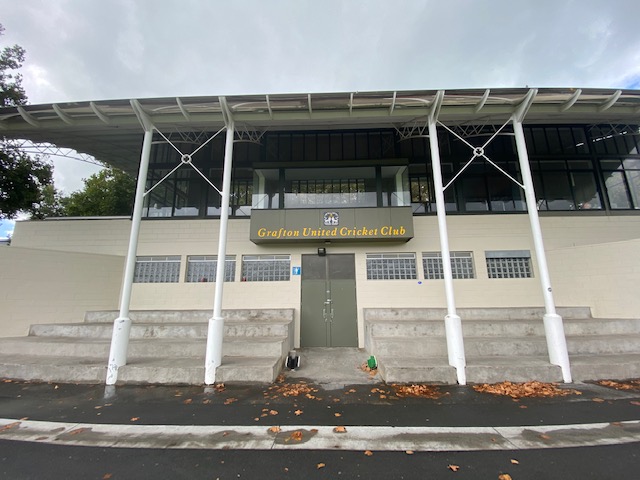
Having been built on reclaimed land, the park is entirely flat. While it was virtually empty due to the lockdown, it is normally dotted at this time of the year with cricket players from the local Grafton United Cricket Club which has its clubhouse on the north side of the park.
The park is encircled by London Plane trees that were planted at the time the park opened to give shade for spectators of the cricket games.

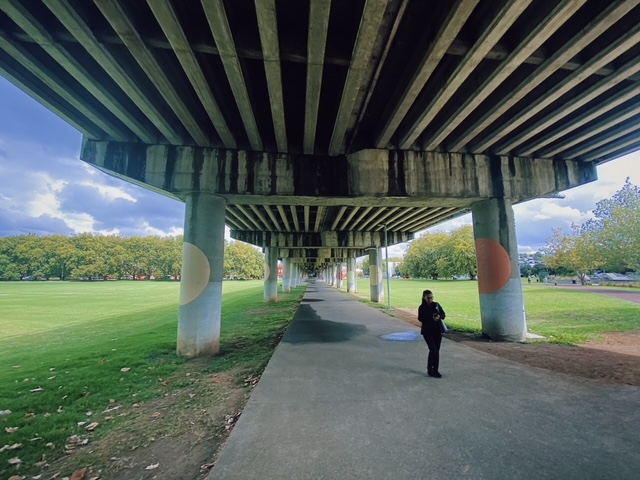
Adding further shade is a highway overpass constructed in the 1960s that bisects the park.

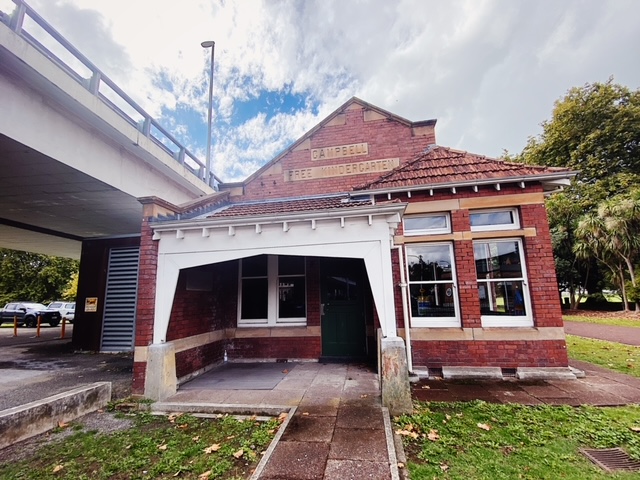
Sitting in the shadow of the highway is the Campbell Kindergarten, paid for by Sir John Logan Campbell, an early Auckland mayor. It is currently being used as a circus school.
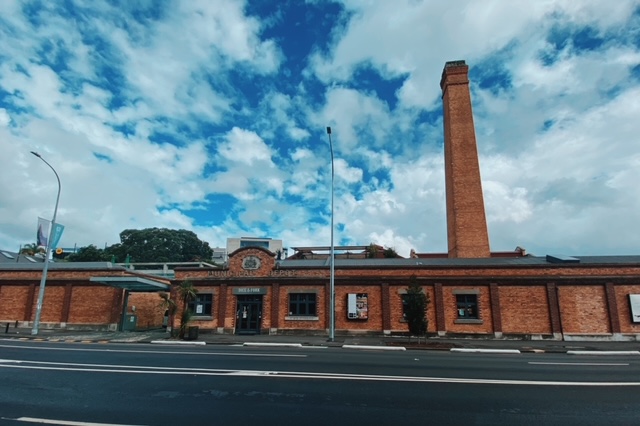
Across the road from the southern edge of the park is Victoria Park Village. Between 1905 and 1915 this was the city’s rubbish incinerator, known as the Destructor. It was decommissioned in 1973 and stood vacant for a number of years until it was reopened as Victoria Park Market in 1983. We remember that market fondly as a vibrant spot full of shops and booths, selling a wide range of clothes and handicrafts by local artisans. However, in 2016, the market underwent an extensive refurbishment and was rebranded as Victoria Park Village. It is a far less vibrant place now and we miss the market’s prior energy.



There is a Celebrity Walk of Fame that includes the foot and handprints of a number of famous New Zealanders. Included are the handprints of Sir Edmund Hillary, the first person to climb Mt. Everest and Dame Kiri Te Kanawa, the Soprano, who among many famous gigs, sang at the wedding of Prince Charles and Princess Di.

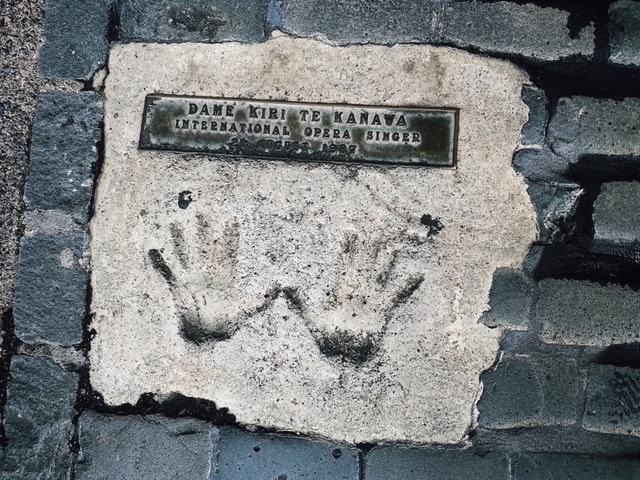
Ed Hillary is so beloved in New Zealand that he is featured on the country’s five dollar note. That got us to thinking how many other countries include depictions of non-political leaders on their money. We have to guess that there aren’t many.
On the hill directly behind Victoria Park Village are a number of new and old factories. Among them is the original factory for C.F. Neary Ltd. Our dear friend, Howard, is the third generation in this business started by his grandfather Clarence in 1918. The business now works out of other premises, continuing to manufacture and restore furniture and shelving. If you need any furniture renovated or built, you definitely should get in touch with Howard. No-one does better and higher quality work than C.F. Neary Ltd.

Sitting next to the market in the shadow of the highway is the Birdcage Hotel, a Victorian pub built in 1885-86. When it was built it sat directly on the quayside of Freeman’s Bay. The entire building was relocated slightly north of its original location following completion of a highway tunnel that lies under the park.

The main street running through Freeman’s bay is Franklin Road. Compared to Washington D.C., Auckland has very few tree-lined streets. Franklin Road is a rare exception. It is lined by plane trees planted in 1873.
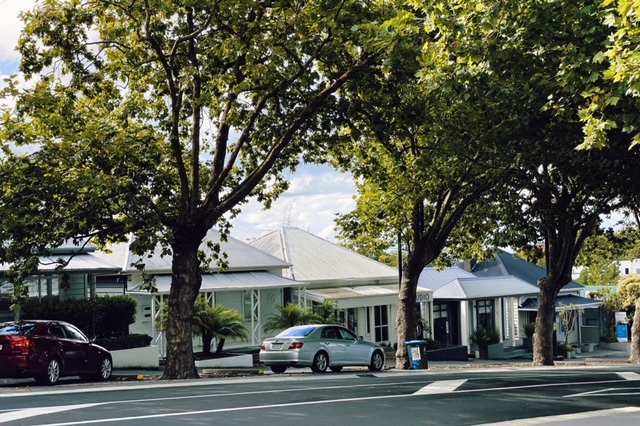
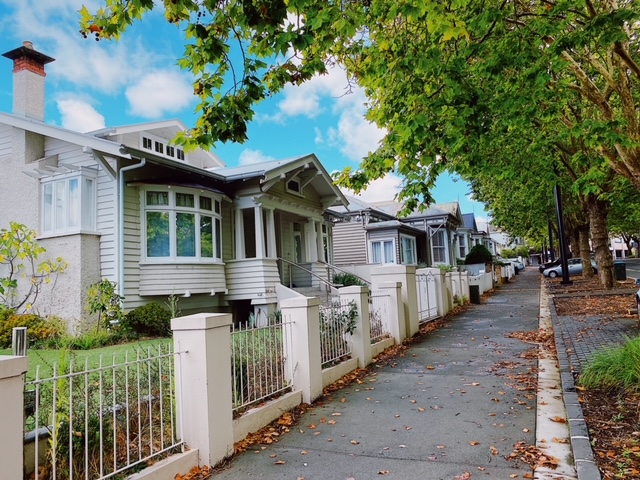
Although many of the houses on Franklin Road are smaller cottages

There are also some larger grander houses lining the road.

Franklin Road is most well-known, however, not for its trees but for its holiday decorations. Every year leading up to Christmas Day, most of the houses put up extensive festive decorations and lights and attract large numbers of onlookers.
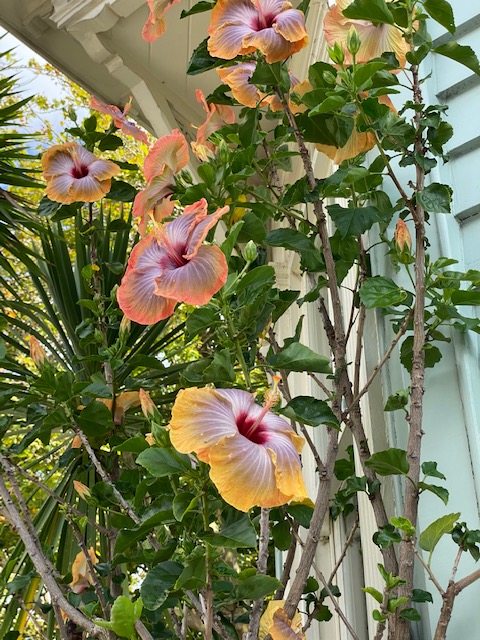
This house had the most unusual hibiscus flowers that we have seen.

We also passed by Blomfield House, built as the home of the painter Charles Bromfield. Bromfield was born in England in 1848 and died in Auckland in 1926. During his life he painted several famous paintings of New Zealand landscapes. The house was built by his brother Samuel, reputedly from a single kauri tree.

There is one other prominent park in Freeman’s Bay. Western Park was opened in 1979 and is one of the oldest parks in Auckland. Unlike Victoria Park which is entirely flat, Western Park is almost entirely on a hillside, extending down from Ponsonby Road toward the bottom of Freeman’s Bay.


We liked this whimsical tree
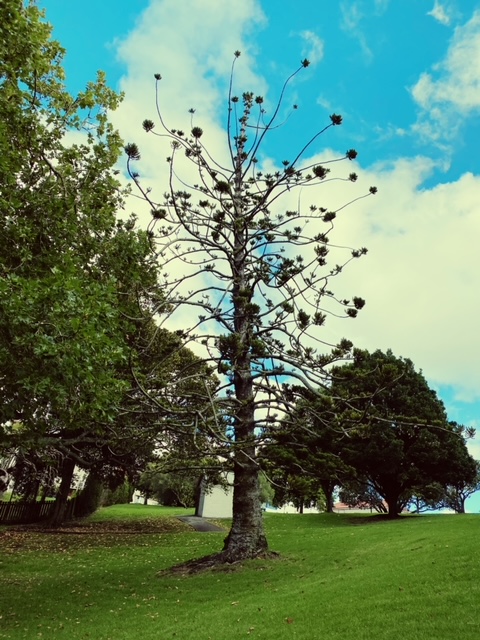
And this pebbles sculpture by John Botica.

At the bottom of the park are some tennis courts and a playground which had some very cool slides.

And a trampoline.

Although Freeman’s Bay consists mainly of single family homes, there are some apartment buildings including these near the bottom of Western Park.
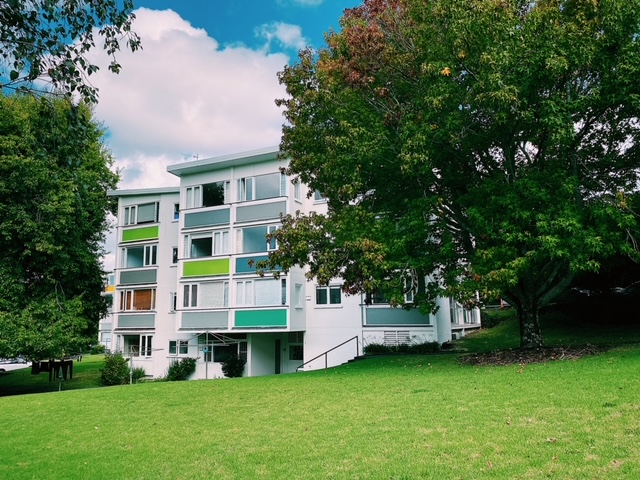
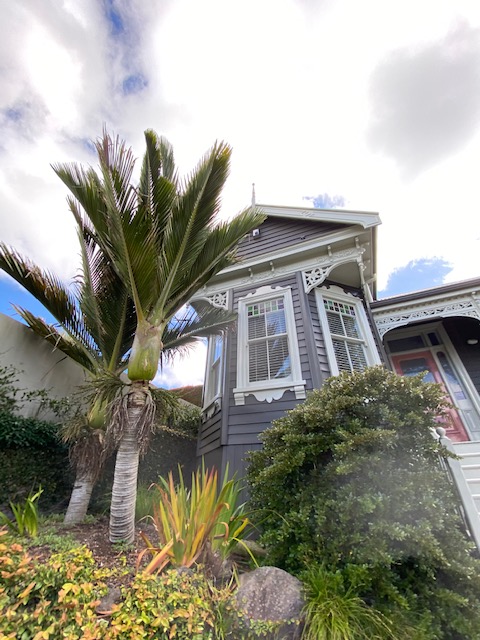
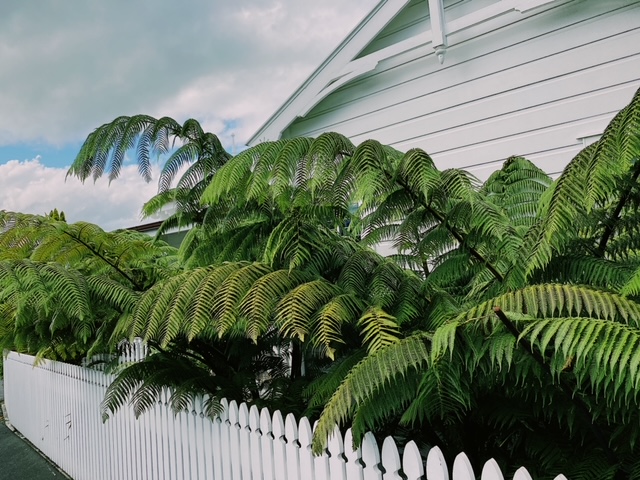
Here is a sample of some of the residences throughout the neighborhood.



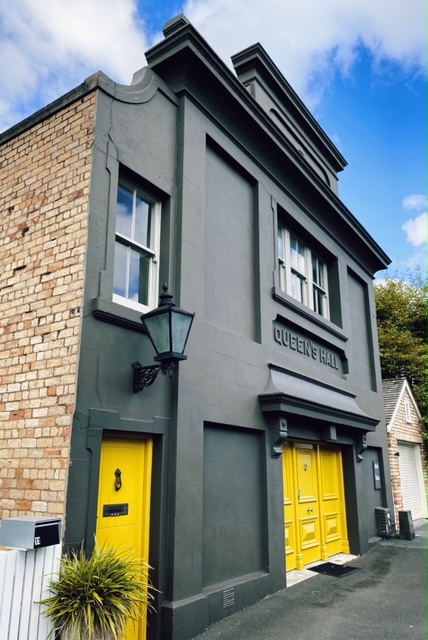


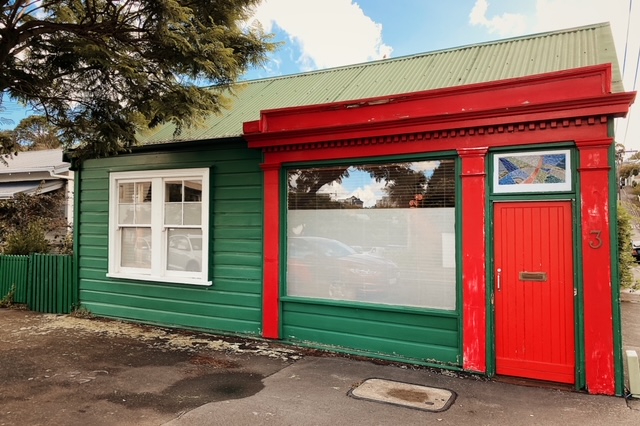
A constant source of frustration for Aucklanders are the endless roadworks that never seem to make any progress. Case in point are these roadworks at the bottom of Hepburn Street which have been there forever. Some sarcastically state that Auckland is fast becoming the “City of Orange Cones” rather than the “City of Sails”.

There are no shortage of cafes in the neighborhood. One of the most distinctive is Queenies, hidden beneath its overflowing ivy.


Speaking of ivy, we liked this ivy covered black wall.
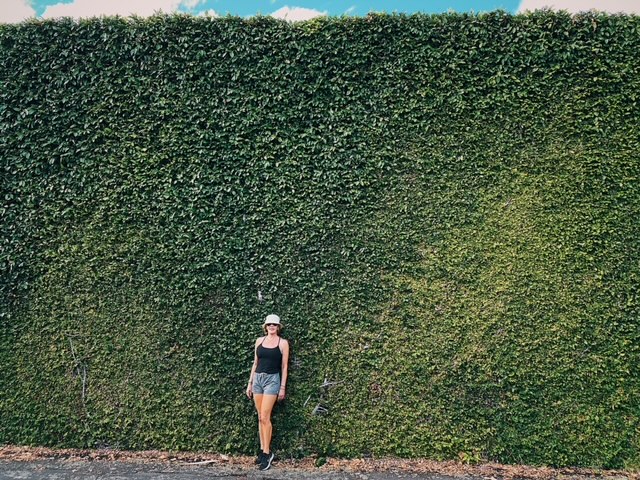
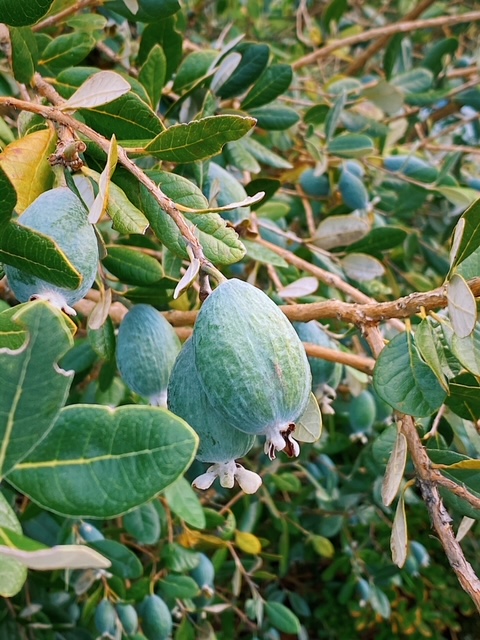
We are big fans of the fruit feijoa, so we were excited to see this feijoa tree overflowing the sidewalk. We’d liken it to a mix between a pear and a banana. Apparently, it is native to South America so we’re not sure how it ended up here!
 Mal and Lauren